


 |
 |
 |
 |
 |
 |
||||
|



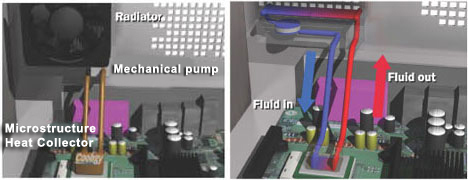
Cooligy’s cooling loop for high-heat flux semiconductors comprises three elements. Fine channels in the Microstructure Heat Collector, etched into a small piece of highly conductive material carry fluid that absorbs heat generated by the chip. The fluid then passes through the Radiator, where heat is transferred to the air. Finally, the cooled fluid returns to the High Reliability Mechanical Pump, where it is pumped in a sealed loop to the Microstructure Heat Collector.
Background
Moore’s Law has proved to be an accurate prediction of improvements in semiconductor processes. With each process generation, manufacturers are able to pack more transistors into the same area and produce chips of greater and greater complexity. Chip speeds have increased to gigahertz clock rates and entire systems have been reduced to a few highly integrated chips.
The cost of this increased speed and integration is a dramatic increase in total heat and in heat density generated by millions of transistors packed into a very small space. In most chips, much of the heat is produced in a very small section of the die, resulting in concentration of heat into very small hot spots. Cooling those spots and removing total heat from the system present tremendous challenges to the system designer.
The Cooligy Solution
Cooligy’s Active Microstructure Cooling Loop is a solution to both challenges. The Cooligy system employs a fluid pumped in a sealed cooling loop. A microstructure heat collector is attached to the chip, efficiently absorbing heat generated by hot spots. The heat travels a very small distance into fluid flowing through channels in the collector, 20 to 100 microns wide each, which transport the heat away from the chip to a radiator, where the heat is rejected to the outside air. The fluid then travels through Cooligy’s reliable mechanical pump to complete the cooling loop.

